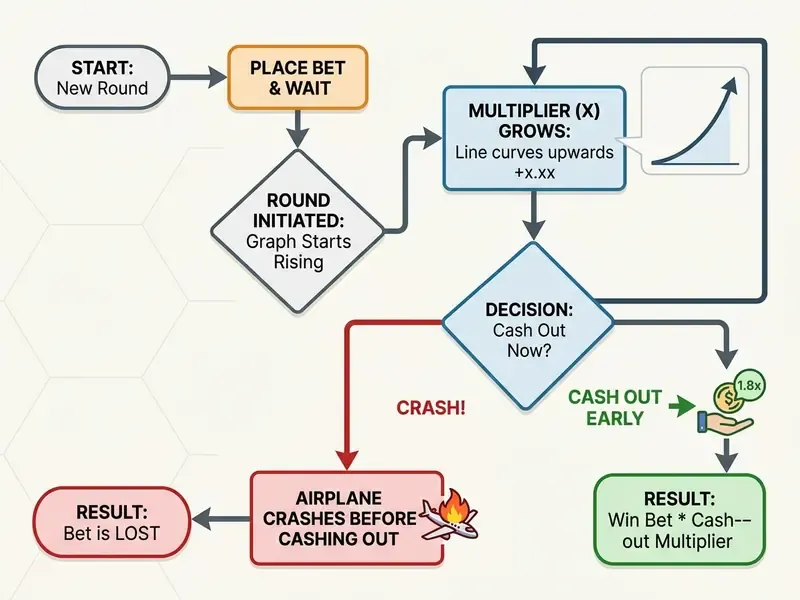
Aviator's demo mode provides a risk-free environment with virtual credits (typically 1,000 to 10,000 credits) and does not require registration on many licensed platforms. The demo uses the same interface, the same algorithms, and the same Random Number Generator as the real-money version. All buttons, the multiplier curve, the Auto Cash Out function, and the dual-bet system work identically.
Here is where free Aviator play genuinely helps:
Learning the interface. New players can familiarise themselves with button placement, timing rhythms, and the feel of the game before risking money. Sounds obvious, but the 10-second betting window catches people off guard the first few times.
Testing Auto Cash Out settings. Experiment with different target multipliers to understand how frequently they hit. Set it at 1.50x for twenty rounds, then try 3.00x for twenty more. The difference in hit rate becomes visceral.
Practising dual-bet strategies. Try the 70/30 split (conservative bet on 1.20x to 1.50x plus an aggressive bet on 3x to 5x) without financial consequences.
Adapting to round speed. Aviator's 15 to 30 second rounds are faster than most casino games. Demo mode helps you calibrate your reaction time and decision-making under time pressure.
What demo mode does not provide: the psychological pressure of real-money play. The emotional experience of watching real money rise and fall is fundamentally different from watching virtual credits fluctuate, and this gap affects decision-making significantly. The in-game chat is disabled in demo, so you also miss the social dynamics that influence behaviour in live play.
A research study on simulated gambling participation (published circa 2023 in a peer-reviewed gambling journal; full citation unavailable, independent verification recommended) found that participation in simulated gambling, especially from home and via social networks, is associated with later onset of real-money gambling among adolescents. Longitudinal research prior to 2023 found that approximately 12% of adolescents in one sample transitioned from simulated gambling to real-money gambling over a survey interval, with home-based play and advertising exposure identified as significant predictors. These findings highlight that demo modes, while useful educational tools, should not be treated as consequence-free activities, especially for younger or vulnerable populations.